

When Cleaning Closets, What Do You Charge For Slightly Worn Clothes?
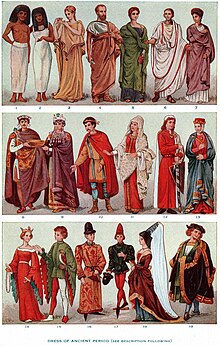
Article of clothing in history, showing (from superlative) Egyptians, Aboriginal Greeks, Romans; Byzantines, Franks; and thirteenth through fifteenth century Europeans

Wear (too known every bit apparel, dress, and attire) are items worn on the torso. Typically, clothing is made of fabrics or textiles, but over fourth dimension it has included garments made from animal peel and other thin sheets of materials and natural products constitute in the surroundings, put together. The wearing of clothing is more often than not restricted to human beings and is a feature of all human societies. The amount and blazon of clothing worn depends on gender, body type, social factors, and geographic considerations. Garments cover the body, footwear covers the anxiety, gloves encompass the hands, while hats and headgear cover the head. Eyewear and jewelry are not generally considered items of wearable, but play an important part in manner and clothing as costume.
Other wearables are not always considered to be clothing despite belonging to an accepted grade, such every bit orthodontic headgear, which is a medical apparatus. The man trunk is not always complete, and sometimes includes prosthetic devices, such every bit a limb prosthesis, which might be adorned similarly to an intact body, differently, or non at all. Some styles of prosthetic legs are designed to require ordinary street shoes to part properly.
Clothing serves many purposes: it can serve as protection from the elements, rough surfaces, sharp stones, rash-causing plants, insect bites, splinters, thorns and prickles by providing a bulwark between the pare and the environs. Clothing tin insulate against cold or hot conditions, and information technology tin provide a hygienic barrier, keeping infectious and toxic materials away from the body. Information technology tin can protect feet from injury and discomfort or facilitate navigation in varied environments. Wearable also provides protection from ultraviolet radiation. It may be used to foreclose glare or increase visual vigil in harsh environments, such as brimmed hats. Habiliment is used for protection against injury in specific tasks and occupations, sports, and warfare. Fashioned with pockets, belts, or loops, clothing may provide a means to carry things while freeing the hands.
Clothing has significant social factors as well. Wearing clothes is a variable social norm. It may connote modesty. Being deprived of clothing in front of others may be embarrassing. In many parts of the world, not wearing clothes in public then that genitals, breasts, or buttocks are visible could be considered indecent exposure. Pubic area or genital coverage is the near frequently encountered minimum institute cross-culturally and regardless of climate, implying social convention every bit the basis of customs. Wear likewise may be used to communicate social status, wealth, grouping identity, and individualism.
Some forms of personal protective equipment amount to clothing, such as coveralls, chaps or a doctor'due south white coat, with like requirements for maintenance and cleaning as other textiles (boxing gloves role both as protective equipment and as a sparring weapon, so the equipment attribute rises to a higher place the glove aspect). More than specialized forms of protective equipment, such as face shields are classified protective accessories. At the far extreme, self-enclosing diving suits or space suits are form plumbing equipment body covers, and amount to a form of apparel, without beingness article of clothing per se, while containing plenty high technology to corporeality to more of a tool than a garment. This line will continue to blur equally article of clothing technology embeds assistive devices directly into the textile itself; the enabling innovations are ultra low power consumption and flexible electronic substrates.
Habiliment also hybridizes into a personal transportation system (ice skates, roller skates, cargo pants, other outdoor survival gear, one-man band) or concealment organization (phase magicians, hidden linings or pockets in tradecraft, integrated holsters for curtained comport, merchandise-laden trench coats on the black market — where the purpose of the wear often carries over into disguise). A mode of dress fit to purpose, whether stylistic or functional, is known every bit an outfit or ensemble.
Origin and history [edit]
Early use [edit]
Scientists take never agreed on when humans began wearing wearing apparel and estimates submitted by various experts have ranged profoundly from 3 meg to 40,000 years ago. More recently, studies involving the evolution of body lice accept pointed to a more recent development, implying the use of dress around 170,000 years ago with others indicating as little as twoscore,000. In September 2021, scientists reported evidence of wearing apparel being made 120,000 years ago based on findings in deposits in Morocco.[ane] [2] However, despite these indications, there is no unmarried estimate that is widely accepted.[3] [4] [5] [6]
Ralf Kittler, Manfred Kayser, and Mark Stoneking, anthropologists at the Max Planck Found for Evolutionary Anthropology, conducted a genetic analysis of homo body lice that suggests clothing originated around 170,000 years ago. Body lice are an indicator of clothes-wearing, since most humans have sparse torso hair, and lice thus require homo clothing to maintain presence on their host. Their research suggests that the invention of clothing may take coincided with the northward migration of modern Homo sapiens away from the warm climate of Africa, thought to have begun between 100,000 and l,000 years agone. A second group of researchers using similar genetic methods judge that clothing originated between 114,000 and thirty,000 years ago.[7]
According to anthropologists and archaeologists, the earliest clothing likely consisted of fur, leather, leaves, or grass that was draped, wrapped, or tied around the body. Knowledge of such clothing remains inferential, since clothing materials deteriorate chop-chop compared to rock, bone, trounce, and metal artifacts. Archeologists have identified very early sewing needles of bone and ivory from about 30,000 BC, found most Kostenki, Russian federation in 1988.[viii] Dyed flax fibers that could accept been used in clothing take been constitute in a prehistoric cave in the Republic of Georgia that date back to 34,000 BC.[ix] [10]
Making wear [edit]
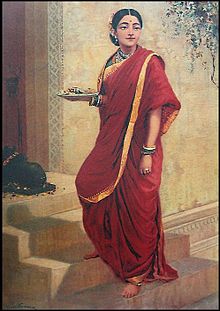
Some human cultures, such as the diverse peoples of the Chill Circle, traditionally make their clothing entirely of prepared and decorated furs and skins. Other cultures supplemented or replaced leather and skins with cloth: woven, knitted, or twined from diverse animal and vegetable fibers including wool, linen, cotton, silk, hemp, and ramie.
Although modern consumers may take the product of wear for granted, making fabric past hand is a tedious and labor-intensive process involving fiber making, spinning, and weaving. The fabric industry was the start to be mechanized – with the powered loom – during the Industrial Revolution.
Unlike cultures have evolved diverse ways of creating clothes out of material. One approach simply involves draping the cloth. Many people wore, and still clothing, garments consisting of rectangles of cloth wrapped to fit – for example, the dhoti for men and the sari for women in the Indian subcontinent, the Scottish kilt, and the Javanese sarong. The wearing apparel may just be tied upwards (dhoti and sari) or implement pins or belts to hold the garments in place (kilt and sarong). The material remains uncut, and people of diverse sizes can wear the garment.
Another approach involves measuring, cut, and sewing the cloth past hand or with a sewing automobile. Clothing tin can be cut from a sewing pattern and adjusted by a tailor to the wearer's measurements. An adjustable sewing mannequin or dress grade is used to create form-fitting wear. If the cloth is expensive, the tailor tries to employ every scrap of the cloth rectangle in constructing the clothing; peradventure cutting triangular pieces from ane corner of the cloth, and adding them elsewhere equally gussets. Traditional European patterns for shirts and chemises have this approach. These remnants can besides be reused to brand patchwork pockets, hats, vests, and skirts.
Mod European fashion treats cloth much less conservatively, typically cutting in such a way as to leave various odd-shaped fabric remnants. Industrial sewing operations sell these equally waste; domestic sewers may turn them into quilts.
In the thousands of years that humans have been making article of clothing, they take created an astonishing array of styles, many of which have been reconstructed from surviving garments, photographs, paintings, mosaics, etc., likewise every bit from written descriptions. Costume history tin can inspire current fashion designers, every bit well as costumiers for plays, films, telly, and historical reenactment.
Clothing as comfort [edit]

Condolement is related to diverse perceptions, physiological, social, and psychological needs, and later food, it is clothing that satisfies these comfort needs. Wear provides artful, tactile, thermal, moisture, and force per unit area comfort.[xi]
- Aesthetic comfort: Visual perception is influenced past colour, fabric structure, style, garment fit, manner compatibility, and cease of clothing material. Aesthetic comfort is necessary for psychological and social comfort.[12] [thirteen] [xiv]
- Thermoregulation in humans and thermophysiological comfort: Thermophysiological comfort is the chapters of the habiliment cloth that makes the balance of moisture and heat between the torso and the environment. It is a holding of textile materials that creates ease by maintaining moisture and thermal levels in a human's resting and active states. The selection of textile cloth significantly affects the condolement of the wearer. Different textile fibers have unique backdrop that make them suitable for use in diverse environments. Natural fibers are breathable and absorb moisture, and synthetic fibers are hydrophobic; they repel wet and do not let air to pass. Dissimilar environments need a diverse selection of article of clothing materials. Hence, the appropriate option is important.[15] [16] [17] [18] [19] [20] [21] The major determinants that influence thermophysiological comfort are permeable construction, oestrus, and moisture transfer rate.[22]
- Thermal condolement: One chief criterion for our physiological needs is thermal comfort. The heat dissipation effectiveness of clothing gives the wearer a neither very hot nor very common cold feel. The optimum temperature for thermal comfort of the peel surface is betwixt 28 and 30 degrees Celsius, i.e., a neutral temperature. Thermophysiology reacts whenever the temperature falls below or exceeds the neutral signal on either side; it is discomforting below 28 and above 30 degrees.[23] Article of clothing maintains a thermal rest; information technology keeps the skin dry and cool. It helps to keep the body from overheating while fugitive heat from the environment.[24] [25]
- Moisture comfort: Moisture comfort is the prevention of a clammy sensation. According to Hollies' research, it feels uncomfortable when more than "50% to 65% of the trunk is moisture."
- Tactile comfort: Tactile comfort is a resistance to the discomfort related to the friction created by wear against the body. Information technology is related to the smoothness, roughness, softness, and stiffness of the fabric used in wear. The degree of tactile discomfort may vary between individuals, which is possible due to various factors including allergies, tickling, prickling, skin abrasion, coolness, and the textile's weight, construction, and thickness. There are specific surface finishes (mechanical and chemical) that can raise tactile comfort. Fleece sweatshirts and velvet habiliment, for example. Soft, clingy, strong, heavy, light, hard, pasty, scratchy, prickly are all terms used to describe tactile sensations.[26] [27] [28] [29]
- Pressure level comfort: The condolement of the human body's pressure receptors' (present in the skin) sensory response towards clothing. Cloth with lycra feels more comfortable because of this response and superior pressure comfort. The sensation response is influenced past the material's structure: snugging, looseness, heavy, calorie-free, soft, or stiff structuring.[30] [31]
Functions [edit]

A video on social expression through dress
The well-nigh obvious part of article of clothing is to protect the wearer from the elements. It serves to prevent wind damage and provides protection from sunburn. In the common cold, it offers thermal insulation. The shelter tin can reduce the functional need for wear. For instance, coats, hats, gloves, and other outer layers are unremarkably removed when entering a warm identify. Similarly, wear has seasonal and regional aspects and then that thinner materials and fewer layers of clothing generally are worn in warmer regions and seasons than in colder ones. Boots, hats, jackets, Panchos, and coats designed to protect from rain and snowfall are specialized clothing items.
Habiliment has been made from a wide diverseness of materials, ranging from leather and furs to woven fabrics to elaborate and exotic natural and synthetic fabrics. Not all trunk coverings are regarded equally article of clothing. Articles carried rather than worn ordinarily are considered accessories rather than clothing (such as Handbags), items worn on a single part of the body and easily removed (scarves), worn purely for adornment (jewelry), or items that do not serve a protective office. For instance, cosmetic eyeglasses, Arctic goggles, and sunglasses would not be considered an accompaniment because of their protective functions.
Wearable protects against many things that might hurt or irritate the naked homo body, including rain, snow, wind, and other weather, as well as from the sun. Garments that are too sheer, thin, small, or tight offer less protection. Appropriate clothes tin too reduce take a chance during activities such as work or sport. Some article of clothing protects from specific hazards, such as insects, toxic chemicals, weather, weapons, and contact with annoying substances.
Humans have devised clothing solutions to environmental or other hazards: such every bit space suits, air conditioned article of clothing, armor, diving suits, swimsuits, bee-keeper gear, motorcycle leathers, high-visibility vesture, and other pieces of protective clothing. The distinction between clothing and protective equipment is not always clear-cut since clothes designed to be fashionable ofttimes accept protective value, and clothes designed for office ofttimes incorporate fashion in their design. The choice of clothes also has social implications. They cover parts of the body that social norms require to be covered, act as a grade of adornment, and serve other social purposes. Someone who lacks the means to procure advisable clothing due to poverty or affordability, or but lack of inclination, sometimes is said to be worn, ragged, or shabby.[32]
Article of clothing performs a range of social and cultural functions, such equally individual, occupational and gender differentiation, and social status.[33] In many societies, norms about clothing reverberate standards of modesty, religion, gender, and social status. Habiliment may also function as beautification and an expression of personal taste or way.
Scholarship [edit]
Office of habiliment [edit]
Serious books on article of clothing and its functions appear from the nineteenth century as European colonial powers interacted with new environments such as tropical ones in Asia.[34] Some scientific research into the multiple functions of wear in the first half of the twentieth century, with publications such every bit J.C. Flügel'southward Psychology of Dress in 1930,[33] and Newburgh's seminal Physiology of Estrus Regulation and The Science of Habiliment in 1949.[35] Past 1968, the field of environmental physiology had advanced and expanded significantly, but the science of article of clothing in relation to environmental physiology had inverse little.[36] There has since been considerable research, and the noesis base has grown significantly, but the main concepts remain unchanged, and indeed, Newburgh'south book continues to be cited by contemporary authors, including those attempting to develop thermoregulatory models of clothing development.[37] [ further caption needed ]
History of clothing [edit]
Wear reveals much nearly human being history. Co-ordinate to Professor Kiki Smith of Smith College, garments preserved in collections are resources for study similar to books and paintings.[38] Scholars effectually the world take studied a wide range of article of clothing topics, including the history of specific items of clothing,[39] [40] vesture styles in different cultural groups,[41] and the business of wear and fashion.[42] The textile curator Linda Baumgarten writes that "vesture provides a remarkable picture of the daily lives, beliefs, expectations, and hopes of those who lived in the past.[43]
Clothing presents a number of challenges to historians. Wear made of textiles or skins is discipline to disuse, and the erosion of physical integrity may be seen every bit a loss of cultural information.[44] Costume collections often focus on of import pieces of vesture considered unique or otherwise significant, limiting the opportunities scholars accept to written report everyday article of clothing.[38]
Cultural aspects [edit]
Gender differentiation [edit]
-

A group of women and men gathered at sport event in Sweden (1938)
In about cultures, gender differentiation of clothing is considered appropriate. The differences are in styles, colors, fabrics, and types.
In contemporay Western societies, skirts, dresses, and high-heeled shoes are usually seen as women's clothing, while neckties ordinarily are seen equally men's vesture. Trousers were in one case seen as exclusively men'south wearable, just nowadays are worn by both genders. Men's clothes are often more practical (that is, they can function well under a wide variety of situations), but a wider range of clothing styles is available for women. Typically, men are allowed to bare their chests in a greater variety of public places. It is by and large mutual for a adult female to article of clothing habiliment perceived as masculine, while the opposite is seen as unusual. Contemporary men may sometimes choose to article of clothing men's skirts such as togas or kilts in particular cultures, especially on ceremonial occasions. In previous times, such garments ofttimes were worn as normal daily wearable past men.
In some cultures, sumptuary laws regulate what men and women are required to wear. Islam requires women to wear certain forms of attire, usually hijab. What items required varies in different Muslim societies; however, women are usually required to cover more than of their bodies than men. Articles of article of clothing Muslim women wear under these laws or traditions range from the head-scarf to the burqa.
Some gimmicky article of clothing styles designed to be worn by either gender, such as T-shirts, have started out as menswear, but some articles, such as the fedora, originally were a style for women.
[edit]
-
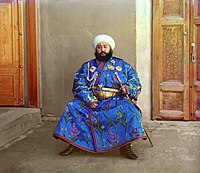
Alim Khan's bemedaled robe conveys a social message about his wealth, status, and power
In some societies, clothing may exist used to indicate rank or status. In aboriginal Rome, for instance, only senators could wear garments dyed with Tyrian royal. In traditional Hawaiian society, only high-ranking chiefs could wear feather cloaks and palaoa, or carved whale teeth. In Communist china, before establishment of the republic, only the emperor could wear yellow. History provides many examples of elaborate sumptuary laws that regulated what people could wear. In societies without such laws, which includes nearly modern societies, social status is signaled by the purchase of rare or luxury items that are express by cost to those with wealth or status. In improver, peer pressure influences habiliment pick.
Organized religion [edit]
-

The Buddha wearing kāṣāya robes, originating from ancient India, these robes were worn by fully ordained Buddhist monks and nuns
-
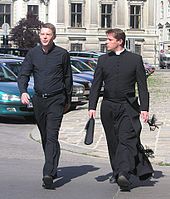
Some religious clothing might be considered a special instance of occupational clothing. Sometimes it is worn merely during the performance of religious ceremonies. Nevertheless, it likewise may be worn every solar day as a marker for special religious status.[ citation needed ] Sikhs wear a turban as it is a part of their organized religion.
In some religions such equally Hinduism, Sikhism, Buddhism, and Jainism the cleanliness of religious dresses is of paramount importance and is considered to indicate purity. Jewish ritual requires rending of 1's upper garment equally a sign of mourning.[ further explanation needed ] The Quran says most husbands and wives, regarding clothing: "...They are clothing/covering (Libaas) for you lot; and you lot for them" (affiliate two:187).Christian clergy members wear religious vestments during liturgical services and may habiliment specific non-liturgical clothing at other times.
Wearable appears in numerous contexts in the Bible. The most prominent passages are: the story of Adam and Eve who made coverings for themselves out of fig leaves, Joseph'south glaze of many colors, and the clothing of Judah and Tamar, Mordecai and Esther. Furthermore, the priests officiating in the Temple in Jerusalem had very specific garments, the lack of which made one liable to death.
Contemporary clothing [edit]
Western apparel code [edit]
The Western apparel code has changed over the by 500+ years. The mechanization of the textile industry made many varieties of textile widely available at affordable prices. Styles have changed, and the availability of synthetic fabrics has inverse the definition of what is "stylish". In the latter half of the twentieth century, bluish jeans became very popular, and are now worn to events that unremarkably demand formal attire. Activewear has also become a large and growing marketplace.

Jacket by Guy Laroche, from a adult female'due south suit with a blackness skirt and blouse (1960)
In the Western wearing apparel lawmaking, jeans are worn by both men and women. There are several unique styles of jeans plant that include: loftier rise jeans, mid rise jeans, low rising jeans, bootcut jeans, direct jeans, cropped jeans, skinny jeans, cuffed jeans, boyfriend jeans, and capri jeans.
The licensing of designer names was pioneered past designers such as Pierre Cardin, Yves Saint Laurent, and Guy Laroche in the 1960s and has been a mutual practice within the fashion industry from about the 1970s. Amongst the more popular include Marc Jacobs and Gucci, named for Marc Jacobs and Guccio Gucci respectively.
Spread of western styles [edit]

By the early years of the twenty-first century, western habiliment styles had, to some extent, become international styles. This process began hundreds of years earlier, during the periods of European colonialism. The process of cultural dissemination has been perpetuated over the centuries, spreading Western civilisation and styles, nearly recently equally Western media corporations have penetrated markets throughout the world. Fast manner clothing has also become a global phenomenon. These garments are less expensive, mass-produced Western wear. Besides, donated used article of clothing from Western countries is delivered to people in poor countries by clemency organizations.
Indigenous and cultural heritage [edit]
People may wear indigenous or national dress on special occasions or in certain roles or occupations. For instance, most Korean men and women have adopted Western-mode wearing apparel for daily habiliment, just yet wear traditional hanboks on special occasions, such as weddings and cultural holidays. Also, items of Western dress may be worn or accessorized in distinctive, non-Western ways. A Tongan human may combine a used T-shirt with a Tongan wrapped skirt, or tupenu.
Sport and activity [edit]
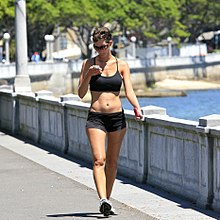
For practical, comfort or safe reasons most sports and physical activities are practiced wearing special clothing. Common sportswear garments include shorts, T-shirts, tennis shirts, leotards, tracksuits, and trainers. Specialized garments include wet suits (for swimming, diving, or surfing), salopettes (for skiing), and leotards (for gymnastics). Besides, spandex materials often are used as base layers to soak up sweat. Spandex is preferable for agile sports that require form fitting garments, such as volleyball, wrestling, rail and field, trip the light fantastic toe, gymnastics, and pond.

Fashion [edit]
Paris set the 1900–1940 fashion trends for Europe and North America.[45] In the 1920s the goal was all about getting loose. Women wore dresses all day, every 24-hour interval. 24-hour interval dresses had a drop waist, which was a sash or belt effectually the low waist or hip and a brim that hung anywhere from the talocrural joint on up to the articulatio genus, never above. Daywear had sleeves (long to mid-bicep) and a skirt that was direct, pleated, hank hemmed, or tiered. Jewelry was non conspicuous.[46] Hair was oft bobbed, giving a boyish look.[47]
In the early twenty-first century a diverse range of styles exists in fashion, varying by geography, exposure to modern media, economic conditions, and ranging from expensive haute couture, to traditional garb, to thrift store grunge. Mode shows are events for designers to show off new and often extravagant designs.
Political issues [edit]
Working conditions in the garments manufacture [edit]


Safety garb for women was designed to forbid occupational accidents among war workers, Los Angeles display (c. 1943)
Although mechanization transformed almost aspects of man vesture industry by the mid-twentieth century, garment workers have continued to labor under challenging atmospheric condition that demand repetitive transmission labor. Often, mass-produced habiliment is made in what are considered past some to be sweatshops, typified past long work hours, lack of benefits, and lack of worker representation. While most examples of such conditions are found in developing countries, clothes fabricated in industrialized nations may besides be manufactured under like conditions.[ citation needed ]
Coalitions of NGOs, designers (including Katharine Hamnett, American Dress, Veja, Quiksilver, eVocal, and Edun), and campaign groups such as the Make clean Wearing apparel Campaign (CCC) and the Institute for Global Labour and Man Rights every bit well as textile and article of clothing trade unions have sought to improve these conditions past sponsoring awareness-raising events, which draw the attending of both the media and the general public to the plight of the workers.
Outsourcing production to low wage countries such as Bangladesh, China, India, Indonesia, Pakistan, and Sri Lanka became possible when the Multi Fibre Agreement (MFA) was abolished. The MFA, which placed quotas on textiles imports, was deemed a protectionist measure out.[ citation needed ] Although many countries recognize treaties such every bit the International Labour Organization, which attempt to set standards for worker safe and rights, many countries take made exceptions to certain parts of the treaties or failed to thoroughly enforce them. Bharat for example has not ratified sections 87 and 92 of the treaty.[ citation needed ]
The production of textiles has functioned as a consistent manufacture for developing nations, providing piece of work and wages, whether construed every bit exploitative or not, to millions of people.[48]
Fur [edit]
The use of animate being fur in clothing dates to prehistoric times. Currently, although fur is still used by indigenous people in arctic zones and higher elevations for its warmth and protection, in adult countries it is associated with expensive, designer clothing. One time uncontroversial, recently information technology has been the focus of campaigns on the grounds that campaigners consider it fell and unnecessary. PETA, along with other animal rights and animal liberation groups have chosen attention to fur farming and other practices they consider cruel.
Life cycle [edit]
Clothing maintenance [edit]
Clothing suffers assault both from within and without. The human body sheds skin cells and body oils, and it exudes sweat, urine, and feces that may soil clothing. From the outside, sun damage, moisture, abrasion, and dirt assault garments. Fleas and lice can hide in seams. If not cleaned and refurbished, clothing becomes worn and loses its aesthetics and functionality (equally when buttons fall off, seams come undone, fabrics thin or tear, and zippers fail).
Oftentimes, people wear an item of clothing until it falls autonomously. Some materials nowadays problems. Cleaning leather is difficult, and bawl cloth (tapa) cannot be washed without dissolving information technology. Owners may patch tears and rips, and brush off surface clay, but materials such as these inevitably age.
Most clothing consists of cloth, nevertheless, and most cloth can exist laundered and mended (patching, darning, only compare felt).
Laundry, ironing, storage [edit]
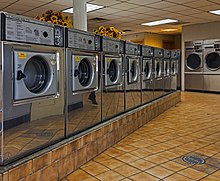
Humans accept developed many specialized methods for laundering clothing, ranging from early methods of pounding clothes confronting rocks in running streams, to the latest in electronic washing machines and dry cleaning (dissolving dirt in solvents other than water). Hot water washing (humid), chemical cleaning, and ironing are all traditional methods of sterilizing fabrics for hygiene purposes.
Many kinds of clothing are designed to be ironed before they are worn to remove wrinkles. Most modern formal and semi-formal wearable is in this category (for instance, apparel shirts and suits). Ironed dress are believed to await clean, fresh, and neat. Much contemporary casual habiliment is made of knit materials that do not readily wrinkle, and do not require ironing. Some article of clothing is permanent press, having been treated with a blanket (such as polytetrafluoroethylene) that suppresses wrinkles and creates a shine appearance without ironing. Excess lint or debris may cease up on the clothing in betwixt launderings. In such cases, a lint remover may be useful.
In one case wearing apparel have been laundered and possibly ironed, normally they are hung on apparel hangers or folded, to keep them fresh until they are worn. Clothes are folded to allow them to be stored compactly, to prevent creasing, to preserve creases, or to present them in a more pleasing manner, for instance, when they are put on sale in stores.
Sure types of insects and larvae feed on clothing and textiles, such equally the blackness carpet beetle and wearable moths. To deter such pests, wearing apparel may be stored in cedar-lined closets or chests,[49] or placed in drawers or containers with materials having pest repellent properties, such every bit lavender or mothballs. Airtight containers (such as sealed, heavy-duty plastic bags) may deter insect pest impairment to wear materials as well.
Not-iron [edit]
A resin used for making non-wrinkle shirts releases formaldehyde, which could crusade contact dermatitis for some people; no disclosure requirements exist, and in 2008 the U.S. Regime Accountability Part tested formaldehyde in clothing and institute that generally the highest levels were in non-wrinkle shirts and pants.[50] In 1999, a study of the effect of washing on the formaldehyde levels found that subsequently six months of routine washing, 7 of 27 shirts even so had levels in excess of 75 ppm (the prophylactic limit for directly skin exposure).[51]
Mending [edit]
When the raw material – textile – was worth more labor, information technology fabricated sense to expend labor in saving information technology. In past times, mending was an fine art. A meticulous tailor or seamstress could mend rips with thread raveled from hems and seam edges so skillfully that the tear was practically invisible. Today vesture is considered a consumable particular. Mass-manufactured wear is less expensive than the labor required to repair it. Many people buy a new piece of clothing rather than spend time mending. The thrifty all the same replace zippers and buttons and sew together upward ripped hems, yet. Other mending techniques include darning and invisible mending.
Recycling [edit]

Clothing salvage centre at the General Technology Company (Canada) munitions factory during the Second Earth War
It is estimated that 80 billion to 150 billion garments are produced annually.[52] Used, unwearable clothing can be repurposed for quilts, rags, rugs, bandages, and many other household uses. Neutral colored or undyed cellulose fibers can be recycled into paper. In Western societies, used wearable is ofttimes thrown out or donated to charity (such as through a article of clothing bin). It is also sold to assignment shops, dress agencies, flea markets, and in online auctions. Also, used wearable often is collected on an industrial scale to be sorted and shipped for re-use in poorer countries. Globally, used dress are worth $4 billion, with the U.S. as the leading exporter at $575 million.[53] [54]
Synthetics, which come primarily from petrochemicals, are non renewable or biodegradable.[55]
Excess inventory of clothing is sometimes destroyed to preserve brand value.[56]
Global merchandise [edit]
EU Member States import, in 2018 €166 billion of wearing apparel; 51% come up from outside the EU €84 billion.
Eu fellow member states exported €116 billion of apparel in 2018, including 77% to other EU member states.
Meet as well [edit]
- Children's wear
- Habiliment fetish
- Wearable laws by country
- Cotton recycling
- Dress code
- Global trade of secondhand clothing
- Higg Index
- Listing of iconic dresses
- Organic cotton fiber
- Reconstructed clothing
- Right to clothing
- Sustainable mode
- Textile recycling
- Thermoregulation
- Timeline of requisite dress in Western culture
- Vintage clothing
- Western dress
- Zip-waste fashion
References [edit]
- ^ Hallett, Emily Y.; et al. (16 September 2021). "A worked bone aggregation from 120,000–90,000 year quondam deposits at Contrebandiers Cave, Atlantic Coast,Morocco". iScience. 24 (9): 102988. Bibcode:2021iSci...24j2988H. doi:10.1016/j.isci.2021.102988. PMC8478944. PMID 34622180.
- ^ Davis, Nicola (xvi September 2021). "Scientists observe evidence of humans making clothes 120,000 years ago - Tools and bones in Moroccan cavern could be some of primeval bear witness of the hallmark man behaviour". The Guardian . Retrieved 16 September 2021.
- ^ Ralf Kittler, Manfred Kayser & Marker Stoneking (2003), "Molecular evolution of Pediculus humanus and the origin of article of clothing", Current Biology, thirteen (16): 1414–1417, doi:10.1016/S0960-9822(03)00507-four, PMID 12932325, S2CID 15277254
- ^ Kittler, Ralf; Kayser, Manfred; Stoneking, Mark (2004). "Molecular Evolution of Pediculus humanus and the Origin of Clothing". Electric current Biology. 14 (24): 1414–7. doi:10.1016/j.cub.2004.12.024. PMID 12932325.
- ^ Toups, Melissa A.; et al. (January 2011). "Origin of Wearable Lice Indicates Early Wearable Use by Anatomically Modernistic Humans in Africa". Molecular Biology and Evolution. 28 (ane): 29–32. doi:ten.1093/molbev/msq234. PMC3002236. PMID 20823373.
- ^ Reed, David; et al. (2007). "Pair of lice lost or parasites regained: The evolutionary history of Anthropoid primate lice". BMC Biological science. five (7): 7. doi:10.1186/1741-7007-5-7. PMC1828715. PMID 17343749.
- ^ Reed; et al. (2004). "Genetic Analysis of Lice Supports Direct Contact between Modernistic and Archaic Humans". PLOS Biology. ii (eleven): e340. doi:ten.1371/journal.pbio.0020340. PMC521174. PMID 15502871.
- ^ Hoffecker, J., Scott, J., Excavations In Eastern Europe Reveal Ancient Human Lifestyles, University of Colorado at Boulder News Archive, March 21, 2002, colorado.edu Archived 2011-07-19 at the Wayback Automobile
- ^ Balter Yard (2009). "Wearing apparel Make the (Hu) Human being". Science. 325 (5946): 1329. doi:ten.1126/science.325_1329a. PMID 19745126.
- ^ Kvavadze Eastward, Bar-Yosef O, Belfer-Cohen A, Boaretto E, Jakeli N, Matskevich Z, Meshveliani T (2009). "30,000-Yr-Old Wild Flax Fibers". Science. 325 (5946): 1359. Bibcode:2009Sci...325.1359K. doi:10.1126/scientific discipline.1175404. PMID 19745144. S2CID 206520793. Supporting Online Material
- ^ Song, Guowen (2011). Improving Comfort in Clothing. Oxford Philadelphia, Pennsylvania: Woodhead Publishing. p. 22. ISBN978-0-85709-064-5.
- ^ Song, Guowen (2011). Improving Comfort in Clothing. Woodhead Publishing. p. 440. ISBN978-0-85709-064-v.
- ^ "Artful Comfort - an overview | ScienceDirect Topics". www.sciencedirect.com . Retrieved 2021-05-30 .
- ^ Lyle, Dorothy Siegert (1982). Modern textiles. Internet Archive. New York: John Wiley & Sons. p. 29. ISBN978-0-471-07805-0.
- ^ Cubrić, Ivana Salopek; Skenderi, Zenun (March 2013). "Evaluating thermophysiological comfort using the principles of sensory assay". Collegium Antropologicum. 37 (i): 57–64. ISSN 0350-6134. PMID 23697251.
- ^ Vocal, Guowen (2011-01-20). Improving Comfort in Clothing. Elsevier. p. 114. ISBN978-0-85709-064-5.
- ^ Stevens, Katy (2008). Thermophysiological comfort and h2o resistant protection in soft beat protective garments. University of Leeds (School of Design).
- ^ Textile Trends. Eastland Publications. 2001. p. 16.
- ^ Conference, Textile Institute (Manchester, England) (1988). Pre-print of Conference Proceedings: Cloth Found 1988 Annual Earth Conference, Sydney, Commonwealth of australia, ten-13 July. Textile Institute. p. 9. ISBN978-1-870812-08-5.
- ^ Ruckman, J.E.; Murray, R.; Choi, H.South. (1999-01-01). "Engineering of habiliment systems for improved thermophysiological condolement: The event of openings". International Journal of Article of clothing Science and Engineering science. 11 (1): 37–52. doi:10.1108/09556229910258098. ISSN 0955-6222.
- ^ Varshney, R. K.; Kothari, V. K.; Dhamija, S. (2010-05-17). "A written report on thermophysiological comfort properties of fabrics in relation to constituent fibre fineness and cross-exclusive shapes". The Journal of the Textile Institute. 101 (6): 495–505. doi:10.1080/00405000802542184. ISSN 0040-5000. S2CID 135786524.
- ^ Collier, Billie J. (2000). Agreement textiles. Internet Archive. Upper Saddle River, NJ : Prentice Hall. p. 539. ISBN978-0-xiii-021951-0.
- ^ Gagge, A.P.; Stolwijk, J.A.J.; Hardy, J.D. (1967-06-01). "Comfort and thermal sensations and associated physiological responses at diverse ambience temperatures". Ecology Research. one (1): 1–twenty. Bibcode:1967ER......1....1G. doi:10.1016/0013-9351(67)90002-three. ISSN 0013-9351. PMID 5614624.
For steady exposure to cold and warm environments, thermal condolement and neutral temperature sensations lie in the range for physiological thermal neutrality (28°–30°C), in which there is no physiological temperature regulatory effort. Discomfort increases more chop-chop below 28°C than above 30°C, while thermal awareness for both rut and cold increases speedily each side of neutral. Discomfort correlates best with lowering average skin temperature toward common cold environments and with increased sweating toward hot environments. In general, discomfort is associated with a change of average body temperature from 36.5°C.
- ^ Gagge, A. P.; Stolwijk, J. A. J.; Hardy, J. D. (1967-06-01). "Comfort and thermal sensations and associated physiological responses at various ambient temperatures". Environmental Enquiry. i (ane): 1–20. Bibcode:1967ER......1....1G. doi:10.1016/0013-9351(67)90002-three. PMID 5614624.
- ^ Song, Guowen (2011). Improving Condolement in Clothing. Woodhead Publishing. pp. 149, 166. ISBN978-0-85709-064-five.
- ^ Au, M.F. (2011). Advances in Knitting Technology. Woodhead Publishing. ISBN978-one-84569-372-v.
- ^ Song, Guowen (2011). Improving Comfort in Vesture. Woodhead Publishing. pp. 167, 192, 208. ISBN978-0-85709-064-five.
- ^ Song, Guowen (2011). Improving Comfort in Clothing. Woodhead Publishing. pp. 223, 235, 237, 427. ISBN978-0-85709-064-v.
- ^ Das, A.; Alagirusamy, R. (2011-01-01). "Improving tactile comfort in fabrics and article of clothing". Improving Comfort in Clothing. Woodhead Publishing Series in Textiles: 216–244. doi:x.1533/9780857090645.2.216. ISBN978-1-84569-539-ii.
- ^ Song, Guowen (2011). Improving Comfort in Wearable. Woodhead Publishing. pp. 25, 235, 432. ISBN978-0-85709-064-5.
- ^ "Force per unit area Comfort - an overview | ScienceDirect Topics". world wide web.sciencedirect.com . Retrieved 2021-05-30 .
- ^ Baradel, Lacey. "Geographic Mobility and Domesticity in Eastman Johnson's The Tramp." American Art 28.2 (2014): 26–49
- ^ a b Flugel, John Carl (1976) [1930], The Psychology of Clothes, International Psycho-analytical Library, vol. No.18, New York: AMS Printing. First published by Hogarth Press, London, ISBN0-404-14721-6 Culling ISBN 978-0-404-14721-i (This work is one of the earliest attempts at an overview of the psycho-social and practical functions of vesture)
- ^ e.g. Jeffreys, Julius (1858), The British Army in Bharat: Its Preservation past an appropriate Habiliment, Housing, Locating, Recreative Employment, and Hopeful Encouragement of the Troops, London: Longman, Brown, Green, Longmans & Roberts, retrieved 8 September 2010
- ^ Newburgh, Louis Harry, ed. (1968) [1949], Physiology of Oestrus Regulation and The Science of Clothing, New York & London: Hafner Publishing
- ^ Hertig, Bruce A (Feb 1969), "Volume review: Physiology of Rut Regulation and the Scientific discipline of Article of clothing", Journal of Occupational and Environmental Medicine, 11 (2): 100, doi:10.1097/00043764-196902000-00012, PMC1520373 (reviewer's name appears next to Newburgh, but was not the co-author. Meet too reviewer's name at bottom of page).
- ^ Gilligan, Ian (January 2010), "The Prehistoric Development of Clothing: Archaeological Implications of a Thermal Model", Journal of Archaeological Method and Theory, 17 (one): fifteen–80, doi:10.1007/s10816-009-9076-x, S2CID 143004288
- ^ a b Friedman, Vanessa (April 29, 2019). "Should These Clothes Be Saved?". The New York Times.
- ^ Summers, Leigh (2001). Bound to Delight: A History of the Victorian Corset. Oxford: Berg. ISBN185973-530-4.
- ^ Stutesman, Drake (2019). Hat: Origins, Language, Way (1st ed.). London: Reaktion Books. ISBN978-1789141368.
- ^ Cole, Shaun (2000). Don We At present Our Gay Clothes: Gay Men's Wearing apparel in the Twentieth Century. Oxford: Berg. ISBNone-85973-415-4.
- ^ White, Nicola; Griffiths, Ian (2000). The Fashion of Business: Theory, Practice and Epitome. Oxford: Berg. ISBN1-85973-354-9.
- ^ Baumgarten, Linda (2002). What Wearing apparel Reveail. Williamsburg, Virginia: The Colonial Williamsberg Foundation. ISBN0300095805.
- ^ DeSilvey, Caitlin (2006). "Observed Decay: Telling Stories with Mutable Things". Periodical of Cloth Civilization. 11 (iii): 318. doi:10.1177/1359183506068808. S2CID 145167639. Retrieved 12 November 2020.
- ^ Mary Louise Roberts, "Samson and Delilah revisited: the politics of women'southward fashion in 1920s France." American Historical Review 98.3 (1993): 657–684.
- ^ Simon Bliss, "'L'intelligence de la parure': Notes on Jewelry Wearing in the 1920s." Fashion Theory 20.1 (2016): 5–26.
- ^ Steven Zdatny, "The Boyish Await and the Liberated Woman: The Politics and Aesthetics of Women'southward Hairstyles." Fashion Theory 1.four (1997): 367–397.
- ^ European Parliamentary Research Service. "Workers' Conditions in the Fabric and Article of clothing Sector: Just an Asian Thing?" European Parliament, Aug. 2014. www.europarl.europa.eu/EPRS/140841REV1-Workers-atmospheric condition-in-the-cloth-and-article of clothing-sector-only-an-Asian-affair-FINAL.pdf.
- ^ "Cedar Closets 101". Bob Vila. 2017-09-08. Retrieved 2019-06-12 .
- ^ When Wrinkle-Free Habiliment As well Means Formaldehyde Fumes. New York Times.
- ^ Changes of Free Formaldehyde Quantity in Not-iron Shirts by Washing and Storage Archived 2011-07-22 at the Wayback Machine. Journal of Health Science.
- ^ Wicker, Alden (31 January 2020). "Fashion has a misinformation problem". vocalisation.com . Retrieved 22 October 2021.
- ^ Minter, Adam (15 January 2018). "No Ane Wants Your Used Dress Anymore". Bloomberg View . Retrieved 17 January 2018.
- ^ Banigan, Melissa (25 January 2018). "E Africa Doesn't Want Your Mitt-Me-Downs". Racked. Vox Media. Retrieved 26 Jan 2018.
- ^ The Textile Materials Eco Battle Between Natural and Constructed Fabrics "Steven Eastward. Davis, Sweatshirt Station".
- ^ Lieber, Chavie (17 September 2018). "Why fashion brands destroy billions' worth of their own merchandise every year". Vox . Retrieved 17 September 2018.
- ^ "Where do our clothes come up from?".
Farther reading [edit]
- Finnane, Antonia (2008), Changing Clothes in China: Fashion, History, Nation, New York: Columbia University Press, ISBN978-0-231-14350-9 , retrieved 8 September 2010 ebook ISBN 978-0-231-51273-two
- Forsberg, Krister; Mansdorf, Southward.Z (2007), Quick Pick Guide to Chemical Protective Clothing (fifth ed.), Hoboken, New Jersey: John Wiley & Sons, ISBN978-0-470-14681-1 , retrieved viii September 2010
- Gavin, Timothy P (2003), "Clothing and Thermoregulation During Exercise", Sports Medicine, 33 (xiii): 941–947, doi:10.2165/00007256-200333130-00001, PMID 14606923, S2CID 37755781, archived from the original on 2011-07-07, retrieved eight September 2010
- Hollander, Anne L (1993), Seeing Through Clothes, Berkeley: Academy of California Press, ISBN0-520-08231-1 , retrieved 8 September 2010
- Montain, Scott J; Sawaka, Michael North; Cadarett, Bruce Due south; Quigley, Marking D; McKay, James M (1994), "Physiological tolerance to uncompensable heat stress: effects of practice intensity, protective clothing, and climate" (PDF), Journal of Applied Physiology, 77 (ane): 216–222, doi:10.1152/jappl.1994.77.one.216, PMID 7961236, archived from the original (PDF) on 28 June 2011, retrieved 8 September 2010
- Ross, Robert (2008), Clothing, a Global History: or, The Imperialist'due south New Clothes, Cambridge, Great britain: Polity Press, ISBN978-0-7456-3186-eight , retrieved 8 September 2010 Paperback ISBN 978-0-7456-3187-5
- Tochihara, Yutaka; Ohnaka, Tadakatsu, eds. (2005), Environmental Ergonomics: The Ergonomics of Human being Comfort, Wellness and Performance in the Thermal Environment, Elsevier Ergonomics Book Series, vol. 3, Amsterdam & Boston: Elsevier, pp. 315–320, ISBN0-08-044466-0 , retrieved eight September 2010 (see especially sections 5 – 'Habiliment' – & half-dozen – 'Protective clothing').
- Yarborough, Portia; Nelson, Cherilyn N, eds. (2005), "Performance of Protective Wearable: Global Needs and Emerging Markets", Functioning of Protective Wear, W Conshohocken, PA: ASTM International, 8th Vol., ISBN0-8031-3488-half dozen, ISSN 1040-3035, retrieved eight September 2010
External links [edit]
- BBC Wiltshire Dents Glove Museum
- International Textile and Wearing apparel Association, scholarly publications
- German Hosiery Museum (English language language)
- Molecular Evolution of Pediculus humanus and the Origin of Clothing by Ralf Kittler, Manfred Kayser and Marker Stoneking (.PDF file)

Source: https://en.wikipedia.org/wiki/Clothing
Posted by: higgsfink1985.blogspot.com
0 Response to "When Cleaning Closets, What Do You Charge For Slightly Worn Clothes?"
Post a Comment